
Beginner guide
How to Start Drawing: A Beginner's Guide
By Drawcil Editorial · · 4 min read · Updated
Start with the basics
New to drawing and not sure where to begin? This beginner's guide covers the supplies, exercises and habits that help you start drawing and keep improving.
Most people who say "I can't draw" have simply never been shown where to start. Drawing is a skill, and like any skill it grows with small, regular practice. If you're wondering how to start drawing, this guide walks you through exactly what to do: what you need, which exercises to practise first, and how to build a habit that lasts.
You don't need talent, an expensive kit or hours of free time. You need a pencil, some paper and a simple plan.
Why drawing for beginners feels hard (and why it isn't)
The hardest part of learning to draw is usually the gap between what you see in your head and what appears on the page. That gap is normal. It closes as your eyes and hand learn to work together, and the only way to train that is to draw.
Two things make the process far easier:
- Break everything into simple steps. A face, a mug or a pumpkin is just a handful of basic shapes, built up in stages.
- Draw from a reference. Copying a photo or a real object teaches you to observe, which is the real skill behind drawing.
This is the idea behind Drawcil: you take a photo and work through it in four pencil stages, from a rough outline to a finished drawing, so you never face a blank page without a plan.
Step 1: Gather a few simple suplies
You can start today with very little:
- A graphite pencil (an HB or 2B is a good all-rounder)
- A few sheets of ordinary paper or a basic sketchbook
- A pencil sharpener and an eraser
See which tools you need in our previous guide about drawing supplies for beginners.
Step 2: Learn to make confident lines
Before you draw anything recognisable, practise the movements your hand will use all the time. Fill a page with:
- Straight lines drawn quickly from your shoulder, not your wrist
- Curves and circles drawn in one smooth motion
- Overlapping shapes such as boxes, to feel how forms sit in space
Wobbly lines at first are completely normal. The goal is confidence, not perfection. The free Drawabox course is built around exactly these fundamentals, and many beginners use its line and box exercises as a daily warm-up.
Step 3: See everything as simple shapes
This is the single biggest shift in learning to draw. Instead of drawing "a face" or "a flower", look for the circles, ovals, triangles and rectangles underneath.
- A head is an oval.
- A mug is a cylinder.
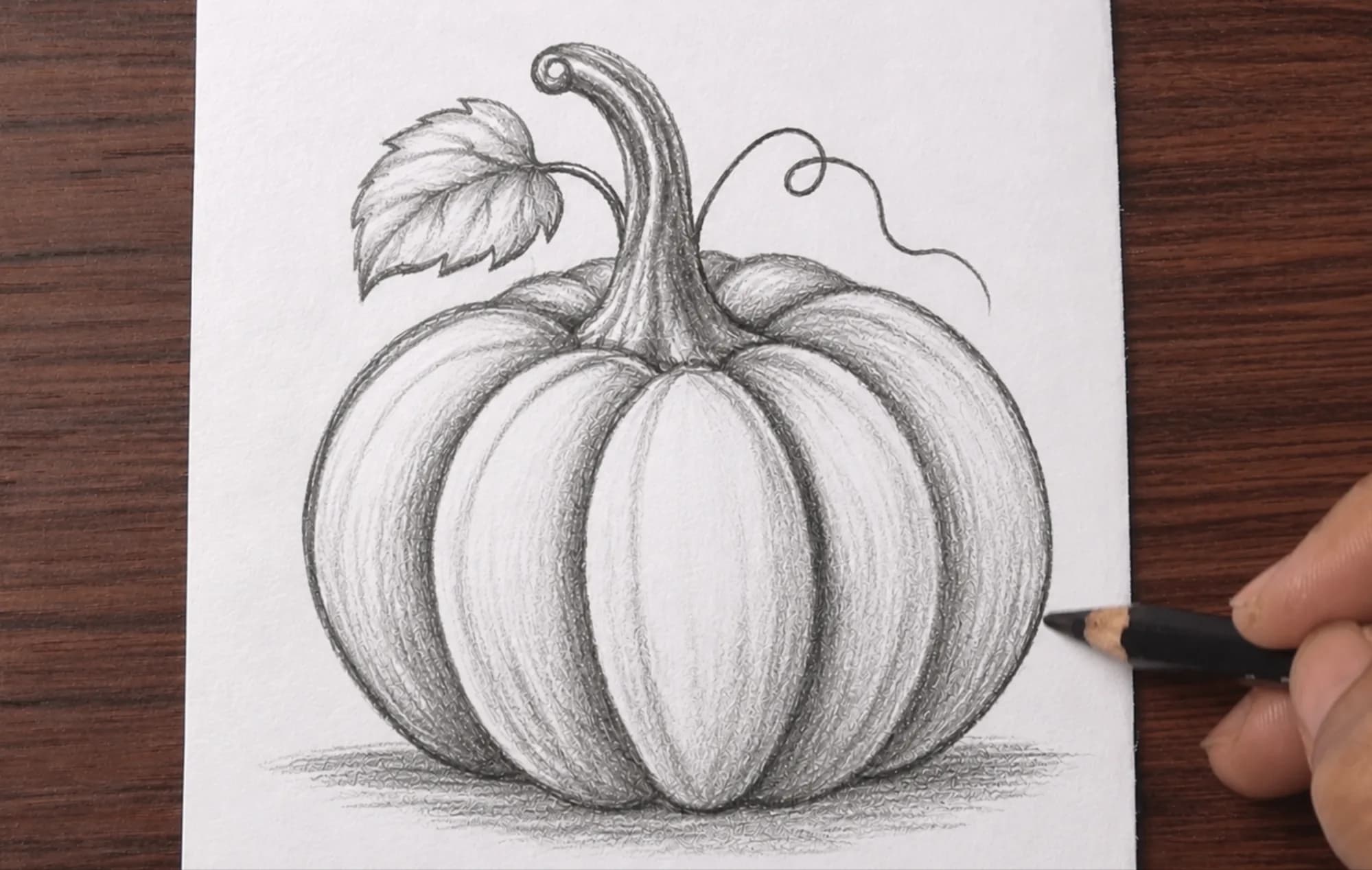
- A pumpkin is a squashed sphere with curved ribs.
Lightly sketch those shapes first, check that the proportions feel right, and only then refine the outline. Light lines are easy to erase, which takes the pressure off getting it right the first time.
Step 4: Add light and shadow
Shading is what turns a flat outline into something that looks solid. Start with just three tones: light, mid and dark. Notice where the light is coming from, and darken the sides of the object that face away from it.
You can build the tones gradually by layering light pencil strokes rather than pressing hard. For a free structured lesson on shading, gesture and measuring, Stan Prokopenko's Proko Drawing Basics course includes a large set of free lessons.
Step 4b: Learn from the classics
If you enjoy reading about technique, the illustrator and teacher Andrew Loomis wrote several influential instruction books that are still widely used today. His approach of building heads and figures from simple forms is a great companion to the shape-first habit above.
Step 5: Practise with easy subjects
Choose subjects that are forgiving. Good first drawings include:
- A coffee mug or cup
- A piece of fruit
- A simple leaf or flower
- A pumpkin
- A pair of shoes
Pick one, find a clear photo or place the real object in front of you, and draw it slowly. If you're stuck for ideas, keep a running list of things around your home you could draw next.
Step 6: Build a small daily habit
Consistency beats long sessions. Ten to fifteen minutes a day will improve your drawing faster than one long session each week. A simple routine:
- Warm up (3 minutes): lines, circles and boxes.
- Main drawing (10 minutes): one simple subject, drawn from reference.
- Review (2 minutes): note one thing you'd do differently next time.
Keep your drawings, even the ones you don't like. Looking back after a month is the best motivation there is.
Common beginner mistakes to avoid
- Pressing too hard. Draw lightly at first so you can adjust.
- Drawing symbols instead of shapes. Your brain wants to draw an "eye" the way you think it looks. Draw what is actually in front of you.
- Erasing too early. Let rough lines stay while you build the drawing, and clean up at the end.
- Comparing yourself to experienced artists. Compare this week's drawing with last month's, not with someone who has practised for years.
- Skipping the reference. Drawing from memory is much harder; use a photo.
Frequently asked questions
Can anyone learn to draw? Yes. Drawing is a learnable skill built on observation and practice, not a gift you either have or don't.
How long does it take to get better? Most beginners notice a clear improvement after a few weeks of regular practice. Significant progress usually takes a few months of steady work.
What should I draw first? Start with simple, solid objects like a mug, a piece of fruit or a pumpkin. They teach shape, proportion and shading without too many details.
Do I need to take a class? Not necessarily. Free resources such as Drawabox and Proko, combined with guided photo-based lessons, are enough to get started.
Your next step
Pick up a pencil and choose one simple object. Spend fifteen minutes drawing it using the shape-first approach above. That's it. You've started.
When you're ready for guided practice, you can turn any photo into a step-by-step drawing lesson with Drawcil.
Put this into practice
Try Drawcil’s drawing app for beginners. See how four illustrated stages, a reference and checkpoints can give your first pencil drawing a starting point.