
Drawing exercises
Drawing Prompts: 30 Ideas to Beat Creative Block
By Drawcil Editorial · · 7 min read
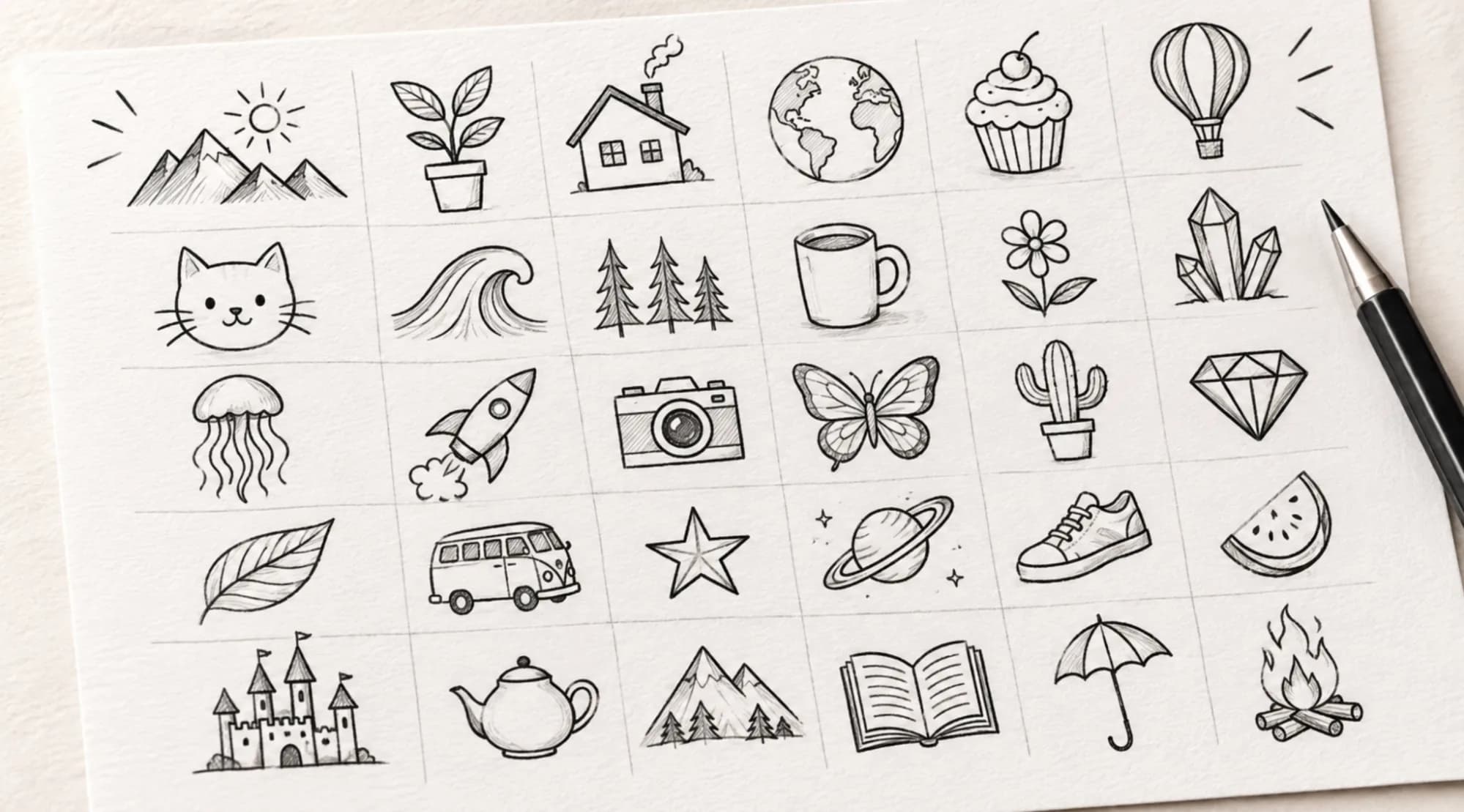
Creative drawing prompts ideas
Thirty original drawing prompts for beginners, grouped by type, plus simple ways to use them and tips to get past a blank page and creative block.
You have your pencil, your sketchbook and a free half hour. And you can't think of a single thing to draw.
That blank-page feeling is incredibly common, and it stops more people from drawing than any lack of talent. The fix is simple: don't start from nothing. A good prompt gives you a starting point, and once your pencil is moving, ideas follow.
Here are 30 original drawing prompts for beginners, grouped by type, along with ways to use them and tips for getting past creative block.
How to use these prompts
- Pick one and set a timer. Ten to twenty minutes is plenty.
- Don't aim for a masterpiece. A prompt is an invitation to play.
- Interpret it freely. There's no wrong answer.
- Use a reference when it helps. Photos and real objects make most prompts easier.
- Fill a page or a sketchbook spread. Several small drawings are often better than one large one.
- Try the same prompt twice. Draw it once quickly, then again more carefully, and compare.
Observation prompts (draw what's in front of you)
These train your eye, and they're the easiest place to start because you don't need to invent anything.
- Your breakfast. Draw whatever is on your plate or in your cup, from the angle you're sitting.
- The shoes by the door. Draw a pair, paying attention to the laces and the shadows.
- Your non-drawing hand. Draw it in three different poses on one page.
- Something in your bag. Pick an object you carry every day and draw it as accurately as you can.
- The view from your window. Draw the first thing that catches your eye, whether it's a tree, a rooftop or a lamp post.
Imagination prompts (invent something)
Use a reference for individual parts, but let your imagination assemble them.
- A tiny house for an unusual creature. What does a snail's holiday cottage look like?
- An object with legs. Give a teapot, a lamp or a shoe a pair of legs and a bit of personality.
- A plant that doesn't exist. Combine the leaves of one plant with the flowers of another.
- A vehicle for a strange journey. It could be a bicycle for the clouds, or a boat for a puddle.
- A door in the middle of a forest. What's behind it? Draw the door, or what lies beyond.
Challenge prompts (use a rule or a limit)
Constraints are brilliant for creativity, because they narrow your choices and make starting easier.
- One continuous line. Draw an object without lifting your pencil.
- Only circles. Build a drawing entirely from circles of different sizes.
- Three values only. Draw something using just light, medium and dark.
- Non-dominant hand. Draw a simple object with your other hand. The wobble can be charming.
- 60 seconds, ten times. Draw the same object ten times, with only a minute for each.
Mood and story prompts (draw a feeling or a moment)
These ask you to think about the message of a drawing as well as its subject.
- A cosy evening. What objects say "cosy" to you? A blanket, a mug, a lamp?
- Something that makes you smile. Draw it, however small.
- A rainy day. Show it using only a few objects and some shading.
- The last piece of something. The last slice of cake, the last leaf on a tree, the last sock in the drawer.
- A quiet morning. Draw an object or a scene that feels calm and still.
Everyday life prompts (find the extraordinary in the ordinary)
These work well for building a daily habit and for developing your own style.
- A messy desk. Draw the clutter as it is, with all its overlapping shapes.
- Your favourite chair. Capture its shape and the way light falls on it.
- Something you'd find in a kitchen drawer. A wooden spoon, a bunch of keys, a tangle of string.
- A pet or a stuffed toy. Choose a favourite, and capture its personality.
- Hands doing something. Pouring tea, tying a shoe, holding a book.
Skill-building prompts (practise something specific)
These turn creative play into targeted practice.
- A sphere in a strong light. Shade it with a core shadow and a cast shadow.
- A group of three objects. Arrange them with overlapping shapes and different heights.
- A row of receding objects. Fence posts, pillars or books on a shelf, getting smaller as they go.
- A face from a photo. Use the proportions in our guide to drawing faces.
- A pumpkin, a mug or a piece of fruit, drawn in stages from rough outline to finished shading.
How to turn a prompt into a full drawing
Any of these prompts can grow into a finished piece:
- Brainstorm. Write or sketch three or four quick ideas for the prompt.
- Choose one and sketch it very lightly, concentrating on big shapes.
- Gather a reference if it would help, such as a photo, a real object or a mirror.
- Refine the structure, checking proportions.
- Add value with light, shadow and texture.
- Finish with details and clean up any construction lines.
This staged approach is also how Drawcil works: you upload a photo and follow four pencil stages, from rough outline to finished drawing. It's a very good answer to a prompt like #4, #22 or #30, using your own photos as the starting point. Try it at drawcil.com.
How to beat creative block
Sometimes a prompt isn't enough. If you feel truly stuck, try these:
- Lower the stakes. Tell yourself you're only going to scribble for five minutes. Even a doodle counts. The history of doodling is a reminder that casual, unplanned marks have a long and respectable history.
- Do a warm-up. Lines, circles and a value strip get your hand moving. See our drawing warm-up exercises.
- Change your materials. Try a different pencil, pen or paper.
- Change your scale. Draw very small, or very large.
- Copy something. Studying and copying a photo for practice is a perfectly good way to learn and to restart.
- Take a walk and take photos. Come back with a folder of references.
- Limit your time. A timer makes starting feel less daunting.
- Draw badly on purpose. Taking away the pressure to be good often frees you up.
- Skip a day if you need to. Rest is part of creativity. Then return with a small, easy drawing.
Build your own prompt system
Once you've used a few prompts, you can make your own:
- A prompt jar. Write ideas on slips of paper and draw one at random.
- Mix and match. Combine an object, a place and a mood: "a teapot, a forest, a quiet morning".
- A running list. Keep a note on your phone of things you'd like to draw.
- Themed weeks. Spend a week on food, hands, plants or buildings.
- A 30-day challenge. Use the 30 prompts above, one a day.
Frequently asked questions
What should I draw when I have no ideas?
Start with something in front of you: an object on your desk, your hand or the view from a window. Observation prompts are the easiest.
How do I get out of an art block?
Lower the pressure, warm up with simple lines and shapes, set a short timer and pick a small, easy prompt.
Are drawing prompts good for beginners?
Yes. They give you a starting point and a goal, which removes the hardest part of drawing: deciding what to draw.
How often should I use prompts?
Daily is great, but even two or three a week help keep your sketchbook moving.
Should I post my prompt drawings?
It's up to you. Sharing can be motivating, but it isn't necessary. Keeping a private sketchbook works just as well.
Draw your first prompt now
Pick a number between 1 and 30. Set a timer for fifteen minutes. Draw whatever comes to mind, without erasing, and stop when the timer goes off. That's it.
When you want more structured projects, Drawcil can turn any photo into a step-by-step pencil drawing lesson.