
Drawing exercises
Sketching vs. Drawing: What Should Beginners Practise First?
By Drawcil Editorial · · 6 min read
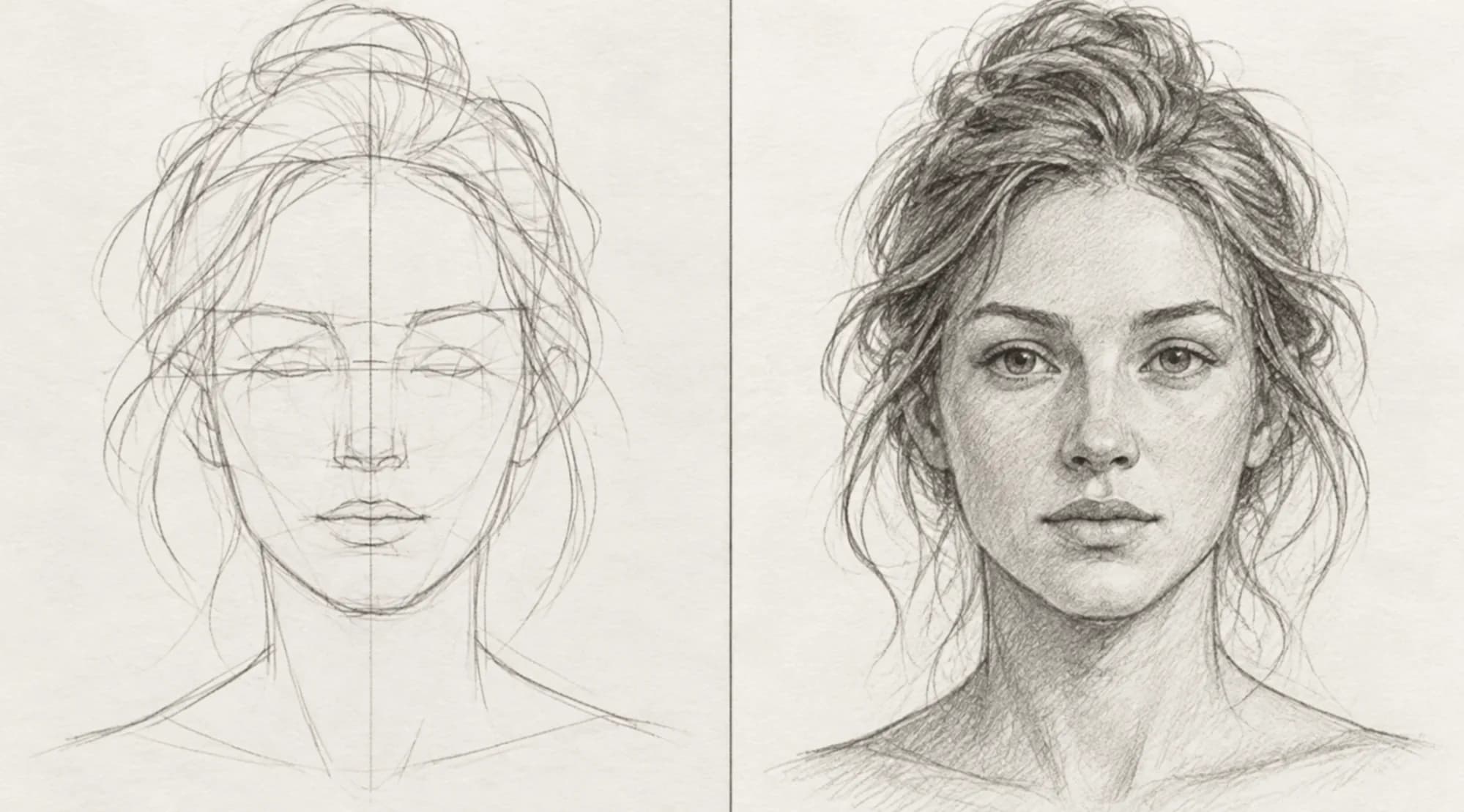
Sketching vs drawing techniques
What's the difference between sketching and drawing, and which should you learn first? A clear guide for beginners with a simple practice plan.
If you've just started learning to draw, you've probably noticed that people use "sketching" and "drawing" as if they mean the same thing. Then you see courses for "sketching for beginners" and "drawing for beginners" side by side, and wonder: which one should I actually practise first?
The short answer is that the two overlap heavily, and a good beginner practice includes both. But understanding the difference will help you decide what to work on, and stop you from feeling stuck when a loose sketch doesn't look like a polished drawing.
What is sketching?
A sketch is a quick, loose drawing made to capture an idea, explore a subject or record something you've seen. Sketches are usually rough, unfinished and fast. The lines are often light and searching, with several attempts layered on top of each other.
If you are interested in the practical application of drawing in design, the article on FOROALFA highlights sketching as a critical, inexpensive tool for rapid iteration, materializing concepts early in the creative pipeline.
Typical features of a sketch:
- Done in minutes, not hours
- Loose, energetic lines
- Little or no detail
- Visible construction lines and corrections
- Often done in a sketchbook
What is drawing?
Drawing is a broader term. It covers any image made by marking a surface, from a two-minute doodle to a hyper-detailed portrait. This article on drawing gives a wide overview of the practice and its many forms.
In everyday use, though, people often use "drawing" to mean a more finished, considered piece: one with accurate proportions, clean lines, careful shading and a clear result.
Typical features of a finished drawing:
- Takes longer, sometimes hours
- Controlled, deliberate lines
- Detailed shading and texture
- Construction lines erased or hidden
- Made to be seen as a complete piece
Sketching vs. drawing: the key differences
| Sketching | Drawing | |
|---|---|---|
| Goal | Capture an idea or movement quickly | Create a finished, refined image |
| Speed | Fast (seconds to minutes) | Slower (minutes to hours) |
| Lines | Loose, light, exploratory | Controlled, deliberate |
| Detail | Minimal | Often high |
| Corrections | Left visible | Cleaned up |
| Mindset | Experimenting, noticing | Refining, completing |
| Typical tools | Soft pencil, pen, sketchbook | Range of pencils, quality paper |
The truth is that these are two ends of a spectrum, not separate activities. A sketch can be detailed, and a drawing can start as a sketch. Most finished drawings begin with a loose sketch stage.
So which should beginners practise first?
Both, but with different aims. Here's how we'd approach it.
Start with sketching to build confidence
Sketching is the best place to start because:
- It lowers the pressure. A sketch doesn't have to be good, so you can relax and experiment.
- It builds line confidence. Fast, flowing strokes train your hand.
- It builds observation skills. Quick studies force you to look at your subject rather than at your paper.
- It produces lots of practice. You can fill a page in minutes.
- It's the first stage of every finished drawing. A good sketch gives you a strong foundation.
Add drawing to learn control and finish
Once your sketches feel comfortable, move on to more careful drawing, because it teaches you:
- Accurate proportions and measurement
- Shading and value
- Patience and attention to detail
- How to complete a piece
If you only sketch, you may never learn to take a drawing to a finished stage. If you only do finished drawings, you may become stiff and slow. The best approach is to alternate.
A simple practice plan for beginners
Here's a balanced weekly rhythm:
- Three days a week: quick sketching (10 to 15 minutes). Do gesture sketches, contour studies and simple objects. Don't erase anything.
- Two days a week: one slower drawing (20 to 30 minutes). Choose a simple subject and work in stages, from rough shapes to detail and shading.
- One day a week: free choice. Draw whatever you enjoy.
- Rest day. Rest is useful, too.
If you need ideas, our guide to drawing exercises for beginners has nine warm-ups, and our post on gesture drawing is a great way to start sketching quickly.
How to sketch: a quick guide
- Use a soft pencil (2B or softer) and hold it loosely.
- Draw big and light. Use your whole arm, and keep your first lines faint.
- Start with the big shapes, not the details.
- Search for the right line. Draw several light lines instead of one heavy one.
- Set a time limit. Try 30 seconds, 1 minute or 5 minutes.
- Don't erase. Keep moving forward.
How to turn a sketch into a drawing
This is the bridge between the two, and it's a great way to practise both:
- Sketch the big shapes and the overall pose or composition lightly.
- Check proportions by comparing sizes and alignments against your reference.
- Refine the outline, choosing the best of your searching lines.
- Clean up by erasing the construction lines you no longer need.
- Add value, building shading in light layers.
- Finish the details last.
This staged approach is exactly how Drawcil works: you upload a photo and get four pencil stages that move from a loose outline to a finished drawing. You can see how it works at drawcil.com.
Which tools suit each?
For sketching:
- A soft graphite pencil (2B or 4B) or a ball-point pen
- An inexpensive sketchbook
- A kneaded eraser, used sparingly
For finished drawing:
- A range of pencils (HB, 2B, 4B)
- Better-quality paper with a little tooth
- Blending stumps and a kneaded eraser
Common misunderstandings
- "Sketching is for people who can draw already." In fact, sketching is the best way for beginners to build skill.
- "A sketch should look good." A sketch should be useful, not pretty. Its job is to explore.
- "Drawing means perfect." Even finished drawings have personality and mistakes.
- "I should pick one." Mixing both gives you the fastest progress.
Frequently asked questions
Is sketching easier than drawing? It's usually less demanding because there's no pressure to finish or perfect. That makes it a good starting point for beginners.
Can I learn to draw without sketching? Technically, yes, but you'd be skipping the stage where most of the learning happens. Almost every finished drawing starts as a sketch.
What's the difference between a sketchbook and a drawing pad? Sketchbooks are designed for everyday practice and are usually cheaper. Drawing pads often have heavier, higher-quality paper that suits finished work.
How long should a sketch take? Anywhere from 30 seconds to about 15 minutes. If it takes longer, you're probably making a drawing.
Which one helps me improve faster? Both, in combination. Sketching builds speed and observation, and drawing builds control and finish.
Your next step
This week, do three quick sketches of everyday objects, 5 minutes each, with no erasing. Then pick your favourite and spend 25 minutes turning it into a more finished drawing. Notice how each stage feels different, and what each one teaches you.
When you want guidance for the second stage, Drawcil can break any photo into step-by-step pencil drawing lessons.