
Drawing exercises
Poses for Drawing: Where to Find Free Reference Poses and How to Use Them
By Drawcil Editorial · · 6 min read
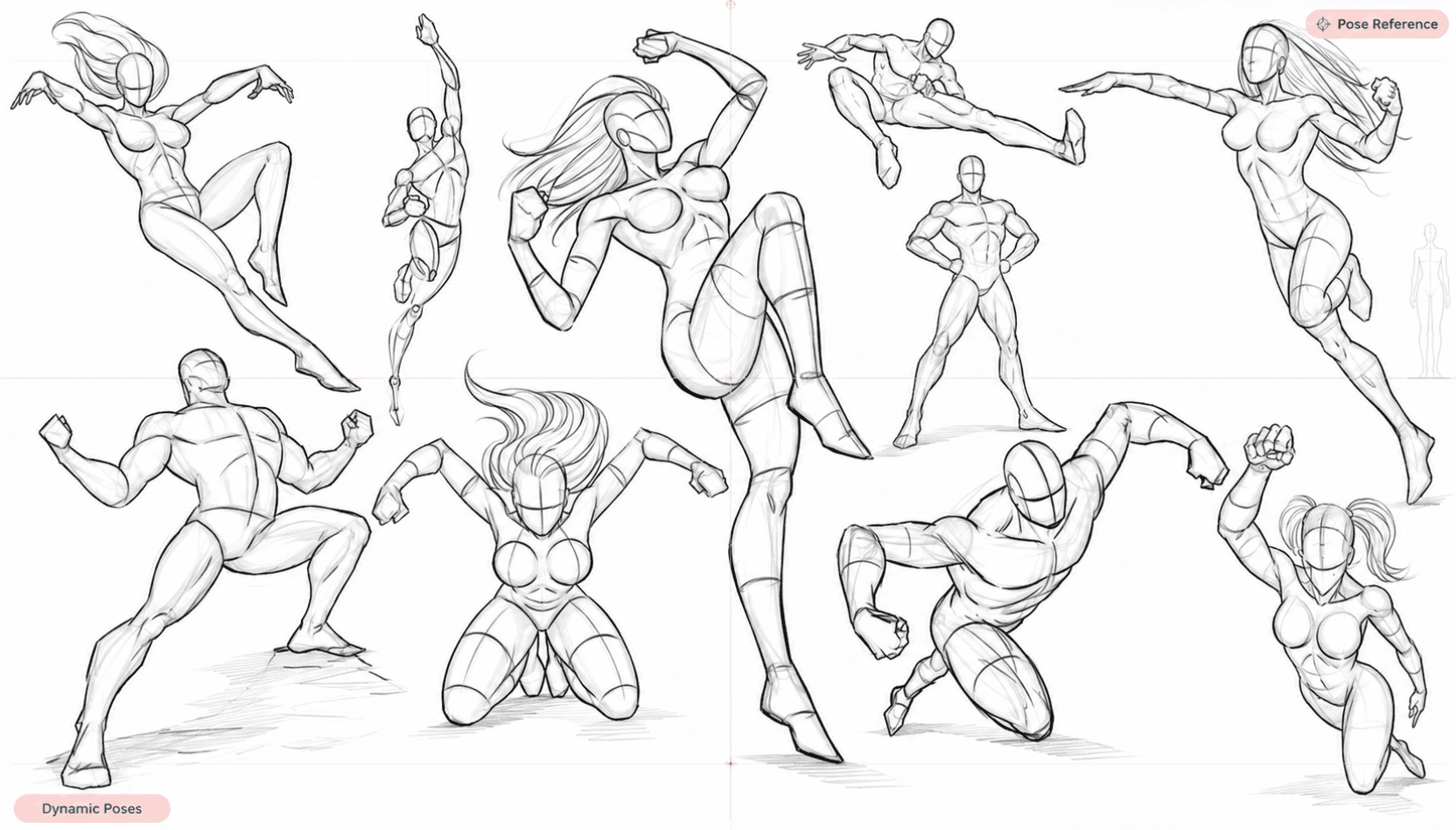
Dynamic drawing poses
Find free reference poses for drawing: timed pose sites, 3D mannequin tools, photo libraries and DIY options, plus a simple practice plan for beginners.
Before you can draw a pose, you have to see one. A model in the room is ideal, but few of us have one on call. That's why artists have built a whole ecosystem of pose-reference tools: websites that show you a figure for 30 seconds, then another, then another, like a life-drawing class on demand.
This guide covers the main kinds of pose references, how to choose between them, and how to build a practice routine around them.
Pair it with our guide to gesture drawing for beginners, which explains what to actually draw once the pose appears.
The Four Types of Pose Reference
1. Timed Photo Libraries
These websites show you a series of photographs, each for a set time, so you can practise drawing quickly.
- Quickposes and Line of Action are two of the most popular options. Concept Art Empire's guide to gesture pose photo websites compares them, noting that Quickposes lets you queue a set number of photos and set a timer, while Line of Action offers a broader mix of galleries, including faces, animals and figures.
- SketchDaily and AdorkaStock offer random-pose and action-pose approaches. A Wacom Community roundup of free pose reference resources describes several of these tools and notes the active forums on Line of Action.
- The comparison article Free Pose Reference Websites offers another perspective and reminds readers that terms of use differ between sites.
Best for: Gesture practice, daily warm-ups and building drawing speed.
2. 3D Mannequin and Posing Tools
These tools let you pose a digital figure, rotate it and change the lighting.
They're especially useful when you need a specific angle that you can't find in a photograph. You can experiment with viewpoints and study how the body changes in perspective.
Our quick sketches guide explains how these tools can support timed practice.
Best for: Difficult angles, foreshortening and planning compositions.
3. Pose Reference Apps
Timed-practice apps bundle pose libraries with timers and session histories.
They're convenient when you want to practise away from your desk, and some make it easier to track your progress and maintain a daily drawing habit.
Best for: Drawing on the go and tracking practice streaks.
4. Create Your Own Pose References
You can make your own references quite easily:
- Photograph yourself using a phone timer. Try poses you can hold comfortably, such as standing, sitting, reaching or twisting.
- Ask a friend or family member to move around while you sketch.
- Draw people in cafes, parks or on the train. Real-life poses are naturally short, making them perfect for gesture drawing.
- Use pets. They provide an endless supply of unrequested poses.
Best for: Learning from real life and avoiding reference-photo licensing worries.
Which Pose Reference Tool Should You Use?
| If you want to... | Try |
|---|---|
| Warm up with quick gestures | A timed photo library |
| Study a specific angle | A 3D posing tool |
| Practise anywhere | A mobile app |
| Avoid copyright questions | Your own photos and real-life subjects |
| Learn how a pose is constructed | Slower, 5–10 minute sessions |
A Few Practical Cautions
- Check the content settings. Some pose libraries include nude models, often with filters or options for clothed figures. Choose what suits you, and consider who may be watching if you work in a shared space.
- Read the terms of use. Drawings based on a site's photographs may have restrictions if you want to sell or publish them.
- Don't rely on just one source. Using several libraries exposes you to different bodies, ages and body types.
How to Practise with Pose References
A simple practice session can help you build speed while gradually improving your understanding of anatomy and movement.
A 27-Minute Pose Drawing Routine
- Warm up (5 minutes): Draw ten 30-second poses. Focus only on the line of action and big masses.
- Build (10 minutes): Draw five 1-minute poses, adding the main shapes of the limbs.
- Study (10 minutes): Draw two 5-minute poses, paying attention to proportion and weight.
- Review (2 minutes): Choose your best and worst drawings, and note why they worked or didn't.
The progression takes you from instinctive movement studies to a better understanding of the human figure.
Beyond Figures: Other Pose References
Pose references aren't just for drawing people. Other subjects can help you develop your observation skills and understand movement.
- Hands: Look for libraries with hand-specific galleries. These pair well with our guide to hand drawing tips.
- Faces and expressions: Useful for portrait drawing and capturing emotion.
- Animals: Great for developing a sense of weight, movement and anatomy.
- Landscapes and environments: Some timed drawing tools include these for quick composition studies.
Common Pose Drawing Mistakes
- Starting with details. In short sessions, focus on capturing movement rather than individual features.
- Using the same few poses. Variety trains your eye and helps you understand different body types and movements.
- Never slowing down. Mix quick gestures with longer studies to develop both speed and accuracy.
- Skipping the review. A minute of reflection after each session is where much of the learning happens.
- Ignoring real life. Photos are convenient, but they don't fully replace observing people and animals in motion.
Further Learning
- Roundup articles: Concept Art Empire reviews pose-reference websites.
- Blog guide: PoseMy.Art's quick sketches guide explains how to use short drawing sessions.
- Video practice: Search YouTube for timed gesture drawing sessions to follow along with guided exercises.
Turn Poses into Finished Drawings
Quick gesture sessions build speed and help you understand movement. But sometimes you'll want to take a pose further and turn it into a finished pencil drawing.
When you're ready, Drawcil can break a photo down into four pencil stages, taking you from a rough outline to a finished drawing.