
Drawing exercises
How to Draw a Simple Flower Step by Step: Daisy, Tulip, Poppy and More
By Drawcil Editorial · · 8 min read
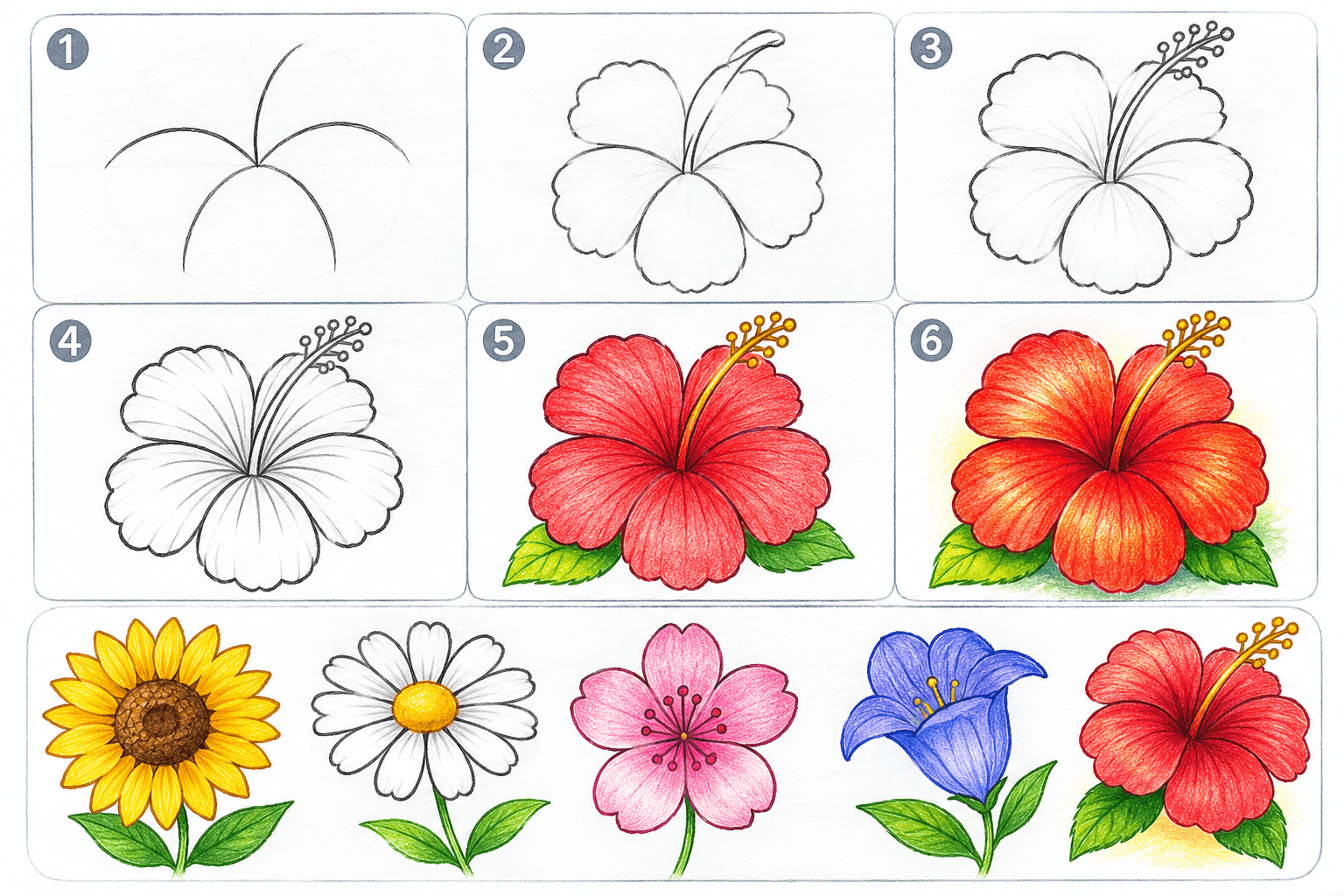
Cute flowers tutorial
Learn how to draw a simple flower in minutes: a four-part formula plus step-by-step daisy, tulip, poppy, lavender and dandelion, with tips for bouquets and colour.
There are thousands of flowers, but beginners only need to know a handful of shapes. Almost every simple flower is built from the same four parts: a centre, some petals, a stem and a few leaves. Change the shape of the petals, and you've changed the flower.
This guide gives you that formula first, then shows five easy flowers (daisy, tulip, poppy, lavender and dandelion) step by step. Each takes only a few minutes, and together they give you a toolkit for filling a page, a card or a bouquet.
The four-part formula
Every flower below follows this recipe:
- Centre: the small circle or shape where the petals attach.
- Petals: the shapes that radiate from or wrap around the centre.
- Stem: a gently curved line, never perfectly straight.
- Leaves: one or two pointed ovals along the stem.
The Artful Haven simple flower doodles tutorial gives a helpful hack: start with a round shape to outline the space for the centre and the petals, so you stay in bounds and the flower gets more dimension. It also reminds you to forget about perfect symmetry. The less symmetrical a flower is, the more interesting it tends to be.
What you'll need
- A pencil and an eraser
- Paper
- Optional: a fine black pen, and coloured pencils or markers
Our guide to drawing supplies for beginners explains the basics.
Flower 1: The daisy
A daisy is the classic first flower: a circle in the middle, with petals all around.
- Draw the centre as a small circle or oval. The Easy Drawing Guides daisy tutorial builds it from many short, connected curved lines, which gives it a slightly textured edge.
- Draw the first petals at the top, bottom, left and right, as long, rounded ovals.
- Fill in the gaps with more petals, varying their length and angle slightly.
- Add a few petals behind, peeking out between the front ones, to give depth.
- Draw the stem, a long curved line, with a leaf on each side.
- Add fine lines along each petal from the centre toward the tip.
Flower 2: The tulip
A tulip is a cup, which makes it the easiest flower to draw from the side.
- Draw a wide oval for the bulb of the flower.
- Divide it into three or four petals. The central one is the largest, with smaller ones flanking it.
- Make the tops pointed or softly scalloped.
- Draw a curved stem and two long, slim leaves wrapping around it.
- Add a curved line inside for the petal folds.
Flower 3: The poppy
A poppy is a loose, papery bowl with a dark centre.
- Draw a small, dark circle with tiny dashes around it for the stamens.
- Draw four large, wide petals around it, as rounded, slightly frilly shapes.
- Make the edges wavy, with a few small creases running from the centre outward.
- Draw a thin, slightly hairy stem that curves as it rises.
- Add small, jagged leaves.
The Art in Context guide to drawing flowers includes a poppy among its eight simple flower drawings, starting with a frame drawn in pencil, then the stem and basic flower shape, then petals.
Flower 4: Lavender
Lavender is a good example of a flower made of many small pieces.
- Draw a long, curvy stem.
- Add small, upright ovals along the top third, in pairs, getting smaller toward the tip.
- Draw two or three narrow leaves near the base.
- Add tiny dots or short lines between the ovals for texture.
The Artful Haven article lists lavender among its easy flowers, and its pattern, a repeated small shape along a stem, works for many other flowers, from wheat to foxgloves.
Flower 5: The dandelion
A dandelion has two lives: the yellow flower, and the white puffball seed head. The puffball is easy and delightful.
- Draw a small circle at the end of a thin, curved stem.
- Draw many fine lines radiating from the circle in all directions.
- Add a small, fluffy tuft at the end of each line.
- Draw a few seeds drifting away, as tiny tufts on thin lines.
- Add a few jagged leaves at the base.
Make any flower your own
With the four-part formula, you can invent flowers:
- Change the petal shape: pointed, round, heart-shaped, frilly.
- Change the number of petals: four, five, eight, twelve.
- Change the centre: a dot, a ring, a dome, a cluster.
- Stack or layer petals for a fuller bloom.
- Add buds, closed, half-open and fully open on the same stem.
Add shading
Even a simple flower benefits from a little tone. Choose a light direction, then:
- Darken the centre and where the petals meet it.
- Add soft shadow under overlapping petals.
- Shade the stem on one side.
- Leave the petal tips light.
From pencil to pen to colour
The Art in Context guide uses a three-stage approach that works for any flower:
- Sketch in pencil, with light lines.
- Outline in fine pen, once you're happy.
- Erase the pencil lines and add colour.
Colour is optional. Many simple flower drawings look lovely in pencil alone.
Draw a bouquet
Once you have a few flowers, combine them:
- Draw a rough oval or fan shape to hold your flowers.
- Place the biggest flower first, slightly off-centre.
- Add two or three smaller flowers at different heights and angles.
- Fill gaps with leaves, buds or small blooms such as lavender.
- Draw the stems meeting at one point below.
- Add a ribbon or a vase if you like.
Vary the sizes, angles and types of flower. Repeating one flower at the same size looks like a pattern, not a bouquet.
Common mistakes
- Perfectly symmetrical petals.
- A ruler-straight stem.
- Flowers all facing the viewer at the same angle.
- No overlaps, so petals look like a row of ovals.
- Pressing too hard in the first sketch.
- Too much detail too soon.
Practice ideas
- Petal page. Fill a page with different petal shapes.
- Centre page. Draw twenty different flower centres.
- Five-flower sheet. Draw all five flowers on a single page.
- Bouquet. Combine three flowers.
- From life. Draw a real flower from a garden or a shop.
Further learning
- Guide: Art in Context's How to Draw Flowers, with eight simple flower drawings.
- Blog tutorial: Artful Haven's simple flower doodles.
- Blog guide: Skillshare's How to Draw Flowers: A Step-by-Step Tutorial by Artists for Everyone.
- Online classes: Skillshare's Botanical Drawing for Beginners: How to Draw Simple Flowers and Learn to Draw Flowers, From Simple Shapes to a More Realistic Drawing (paid platform with free trials).
Draw real flowers
When you're ready to go from simple flowers to realistic ones, upload a flower photo to Drawcil and follow four pencil stages, from rough outline to finished drawing. Our guide to easy things to draw has more subjects to try.