
Drawing exercises
Drawing Warm-Up Exercises to Do Before Every Session (5-Minute Routine)
By Drawcil Editorial · · 6 min read
Drawing warm-up exercises
A quick 5-minute drawing warm-up routine: simple hand and arm stretches, line and circle drills, and a value strip to loosen up before you draw.
You wouldn't go for a run without stretching, and a pianist doesn't sit down and play a concerto cold. Drawing is a physical skill too, and the first few minutes of a session are often the shakiest. Lines wobble, circles come out lopsided and your hand feels stiff.
A short warm-up fixes that. Five minutes of simple drawing warm-up exercises loosens your arm, wakes up your eye and puts you in the right frame of mind, so your actual drawing starts well instead of badly.
Here's a quick routine you can use before every session, and the reasons each part works.
Why warm up before drawing?
- It improves line quality. Warmed-up arms draw smoother, more confident lines.
- It reduces tension. Drawing with a tight grip tires your hand and makes your lines shaky.
- It focuses your mind. A few minutes of simple marks move you out of "daily life" and into drawing mode.
- It builds skills. Repeated daily, warm-ups steadily train line control, shape and value.
- It removes the blank-page fear. Starting with easy, throwaway marks makes it easier to begin the real drawing.
The 5-minute warm-up routine
You'll need a pencil, a sheet of scrap paper or a sketchbook page and a timer.
Step 1: Loosen your arm and hand (1 minute)
Before you pick up a pencil, take a moment to relax your body:
- Shake out your hands and wrists gently for a few seconds.
- Roll your shoulders backwards a few times.
- Stretch your fingers wide, then make a loose fist. Repeat a few times.
- Rotate your wrists slowly in both directions.
Keep every movement gentle. If anything hurts, stop. Persistent pain in your hand, wrist or arm when drawing is worth discussing with a doctor or physiotherapist.
Step 2: Draw loose lines (1 minute)
Hold your pencil lightly and draw from your shoulder:
- Fill a section of the page with long, quick lines in one direction.
- Then fill another with lines in a different direction.
- Try zig-zags and waves, moving your whole arm.
The aim is freedom, not accuracy. If your lines look wild, that's fine. They'll settle down.
Step 3: Practise controlled lines (1 minute)
Now add a little precision. Place two dots about a hand-width apart, then:
- Ghost the line: trace the path in the air above the paper two or three times.
- Draw the line in one confident stroke.
- Repeat between several pairs of dots.
This is the core exercise of the free Drawabox course, where many students use these line and shape exercises as a regular warm-up before drawing.
Step 4: Circles and ovals (1 minute)
Fill a corner of the page with:
- Circles, each drawn in one smooth motion
- Ovals at different angles
- Overlapping circles, like a chain
If a circle isn't closing neatly, go over it a second time, rather than rubbing it out. Circles and ovals underpin heads, fruit, cups and wheels, so every minute counts.
Step 5: A quick value strip (1 minute)
Draw a long, thin rectangle and divide it into five boxes. Fill the first with your lightest tone, the last with your darkest, and the others in between. It warms up your pressure control, which you'll need for shading.
A 2-minute emergency version
Short on time? Do just this:
- Shake out your hands (10 seconds).
- Draw a line of quick lines and a row of circles (1 minute).
- Draw one slow, careful contour line around a nearby object (50 seconds).
Longer warm-ups for when you have time
If you have 10 to 15 minutes, add any of these:
- Gesture sketches. Ten 30-second poses from photos.
- Boxes in perspective. Draw several boxes at different angles, including the hidden edges.
- Hatching squares. Fill small squares with hatching and cross-hatching to practise tone.
- Blind contour. Draw the outline of an object while looking only at the object, not the paper.
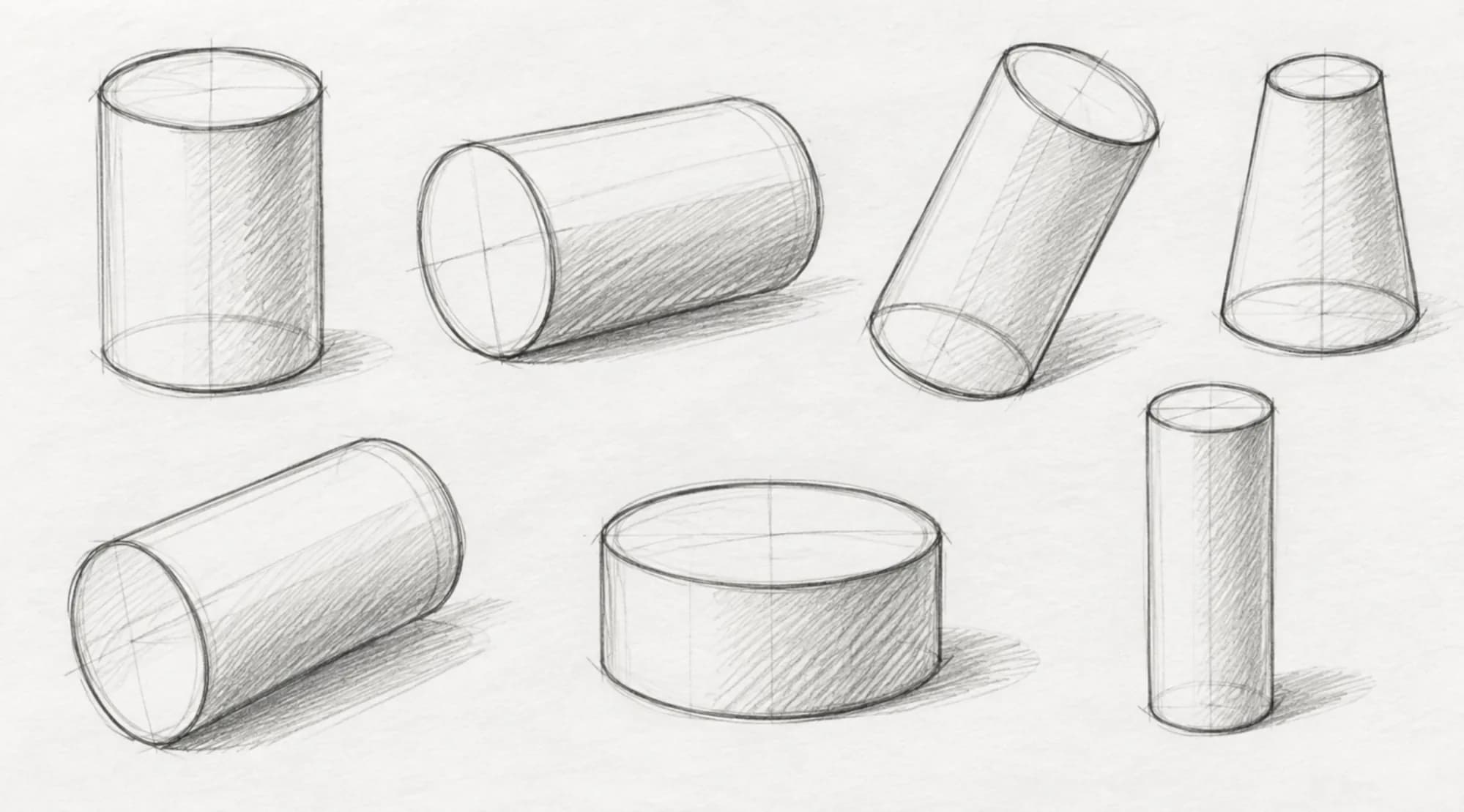
- Shape breakdown. Draw a simple object as a collection of spheres, cylinders and boxes.
Our post on how to start drawing explains each of these in more detail.
Warm-ups for different types of drawing
The warm-up that suits you depends on what you're about to draw:
- Portraits and figures: gesture sketches and a few quick ovals for heads.
- Shading and realism: a value strip and hatching squares.
- Objects and still life: boxes, cylinders and spheres.
- Landscapes and architecture: straight lines and simple perspective boxes.
- Digital drawing: the same line and circle drills on your tablet. They train your stroke just as well on a screen.
Making the warm-up a habit
- Always use the same page. Keep a "warm-up" sketchbook or a folder of scrap paper, so you don't worry about wasting good paper.
- Set a timer. Five minutes goes quickly, and a timer stops you from either skipping it or overdoing it.
- Put it first. Make the warm-up the signal that your session has started.
- Keep it low-stakes. Nobody needs to see these pages.
- Track it. Date your pages and watch your lines get steadier over a few weeks.
Common warm-up mistakes
- Skipping it when you're in a hurry. It's exactly then that a quick warm-up helps most.
- Gripping the pencil too tightly. A death-grip tires you out and ruins your lines.
- Drawing from the wrist only. Use your shoulder and elbow for bigger movements.
- Trying to make it look good. The aim is movement, not a nice picture.
- Making it too long. Five minutes is plenty. Spend the rest of your energy on the real drawing.
Warm up, then draw from a photo
Once you're warmed up, move straight into your main drawing while your hand is loose. If you want a ready-made project, upload a photo to Drawcil and follow its four pencil stages, from rough outline to finished drawing. For more structured free lessons on line, form and shading, take a look at Proko, and our guide to drawing basics shows how the skills fit together.
Frequently asked questions
Do I really need to warm up before drawing?
You don't have to, but even a few minutes makes a noticeable difference to your lines and focus. It also builds skills over time.
How long should a drawing warm-up take?
Five minutes is ideal. Two minutes is better than nothing, and ten to fifteen is good if you have the time.
What are the best warm-up exercises for drawing?
Loose lines, ghosted lines, circles and ovals, and a quick value strip. Add gesture sketches or boxes when you have more time.
Should I warm up for digital drawing, too?
Yes. The same line and circle exercises work on a tablet and help you get used to the pen and screen.
Why do my lines wobble at the start of a session?
Your hand and arm are cold, and you may be gripping tightly or drawing from your wrist. A warm-up and a looser grip usually fix it.
Try it before your next session
Tonight, set a timer for five minutes. Shake out your hands, draw a page of loose lines, a row of ghosted lines, some circles and a value strip. Then start your drawing and notice how much smoother your first lines feel.
When you're ready for a guided drawing to follow, Drawcil can turn any photo into a step-by-step lesson.